中文
中文
Thermonuclear adventures of Pietro Barabaschi in Russia: ITER director’s visit
What keeps Pietro Barabaschi awake at night and what inspires him? Why delays in construction of the International thermonuclear reactor do not affect the project and halts are lethal? News from the spot.
Three days and a dozen of events held in two capitals. Technical tours, meetings, in particular with General Director of Rosatom Alexey Likhachev and the ITER founder, the Honored President of the Kurchatov Institute Evgeny Velikhov. Still, Pietro Barabaschi hopes to spare a moment for a short culture event. “Perhaps we can go to opera in Saint-Petersburg”.
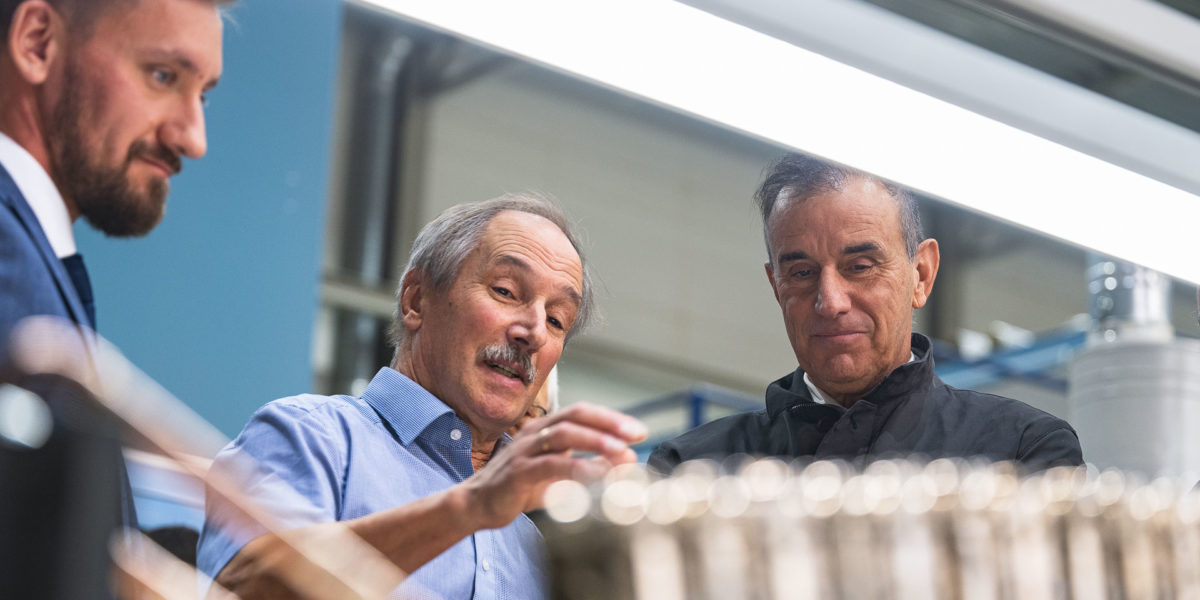
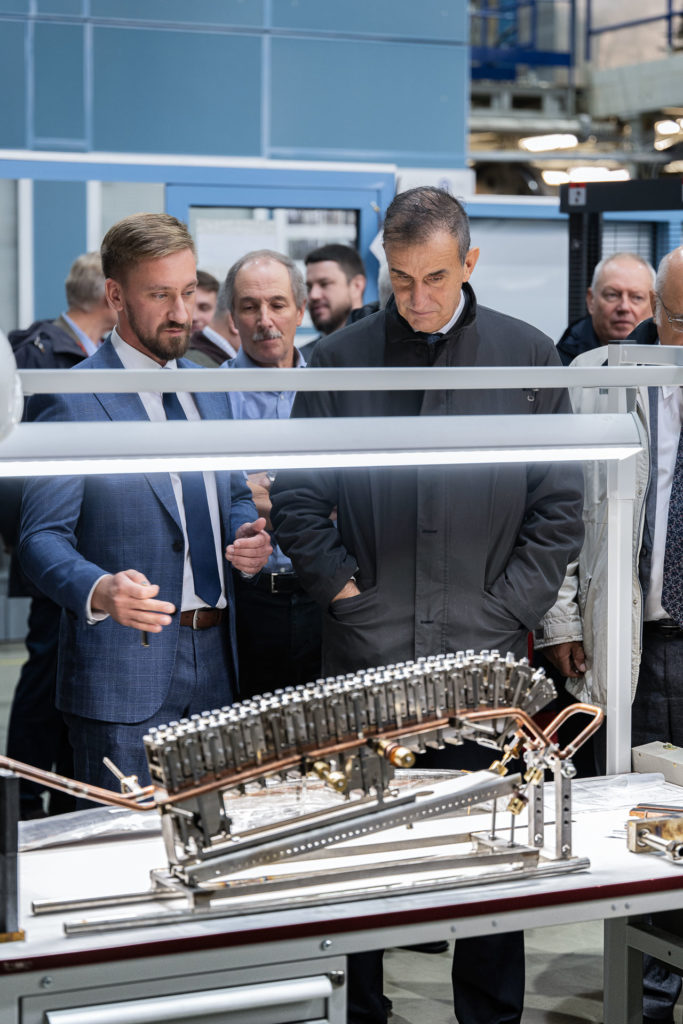
The agenda started with laboratory visit to the Project center ITER (incorporated into Rosatom) in Troitsk. Pietro Barabaschi witnessed growing of artificial monocrystals and development of diagnostic systems designed for fusion reactor. This tour was followed by a videoconference with members of the ITER Council (management body of the project), Rosatom spokespersons and others. Though in a business trip, there are still some regular duties that need to be dealt with.
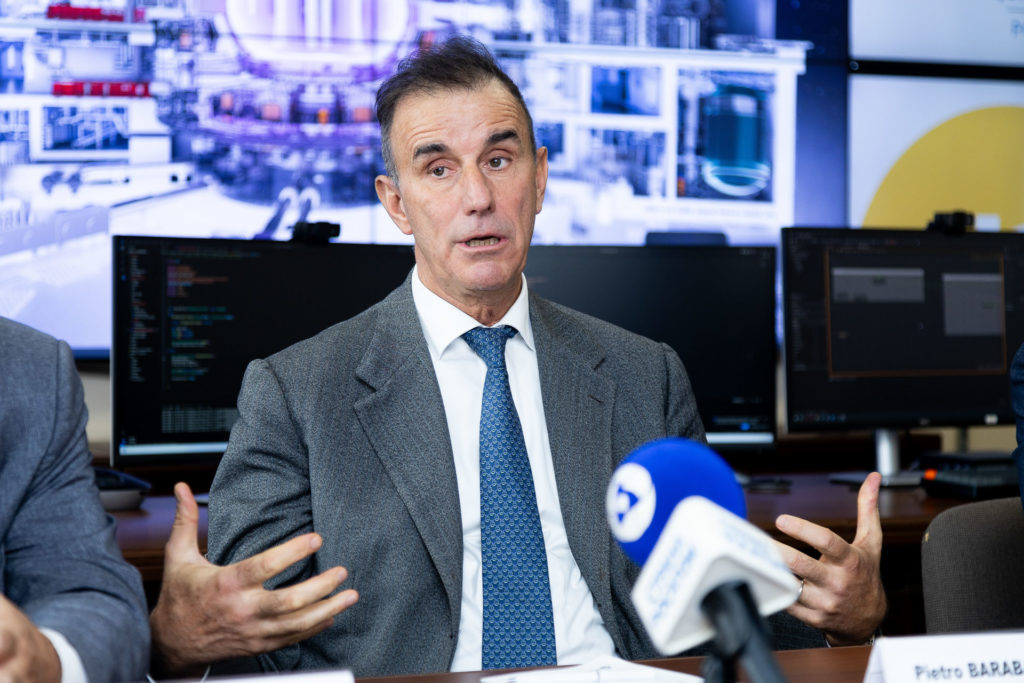
The press conference takes place at a Russian ITER remote participation room, a kind of remote access facility. The monitors behind Pietro Barabaschi and Director of the Project center ITER Anatoly Krasilnikov display the same data, as those observed by operators at ITER construction site in Cadarache, France.
The journalists start with the core question: “Has the approach regarding Russian technologies and experts undergone any changes in view of the recent events?” – “Definitely not”, such was the answer.
“I cannot speak for other international projects but as for ITER, our relationship hasn’t changed a bit. Engineers and scientists from member-states still work together. And I am proud of it” – says Barabaschi.
Concerning his visit to Russia he states: “It is not my place to boost cooperation, as it already exists for a long time and develops successfully. ITER has many locations and one of my duties is to travel around the world and see how they work, meeting with my colleagues. Therefore, I feel at home here and my colleague (cordially taps the shoulder of Anatoly Krasilnikov) feels at home in Cadarache as well”.
“This visit is most important for us”, says Anatoly Krasilnikov. “The ITER project is at its crucial milestone and the participants are engaged in discussion of a new baseline. Lead time and costs can change substantially. Russian companies are in need of comprehensive information directly from the Project leader”.
DELAYS AND PAUSES
Project timeframe has been already shifted: the full energy output was shafted from 2033 to 2036; the full fusion experiment shall take place in 2034-2035. The idea of the first plasma expected to be obtained in 2025 was rejected. “At first this event was supposed to be of a rather symbolic meaning”, explains Pietro Barabaschi. “Then we would turn the reactor off and perform a test campaign in order to finally reach the full energy output”. He compares a tokamak with a car. At first, the ITER experts intended to step on the gas in full on neutral gear. Loud, impressive, yet useless. Moreover, there is a risk to damage the gear box. The new plan implies to step on the gas once the car is ready to go.
The Project head is not concerned with delays. “Maybe we should put on halt construction for several years?”, propose some overexcited journalists. “This endeavor is so costly and member-states meet numerous challenges at this moment. Money can be spent otherwise”. Pietro Barabaschi believes that putting a project at halt is not a good idea: “While running a marathon, you can slow down to catch your breath. However, if you stop for a cigarette or have a meal, your marathon is finished, isn’t it?”.
“It is essential to prepare experts to be engaged in ITER”, emphasizes Anatoly Krasilnikov. “Such a challenge requires 10 years at least. If you interrupt the machine construction, it will interrupt labor generation as well which is quite risky. Any pause is unacceptable, only speed adjustment can be done”.
TECHNICAL INSOMNIA
Naturally, sanctions have affected delivery dates of the Russian hardware for ITER but not drastically. “We find new routes. It takes a little longer and a bit more costly but everything is feasible”, says Anatoly Karilnikov. “We face some difficulties with deliveries of equipment from Russia”, confirms Pietro Barabaschi. “However, in comparison with other project issues it is not that much crucial”. He adds that it used to be much worse in covid times.
Current issues that sometimes deprive the ITER Director of sleep are mostly of technical nature. Vacuum vessel elements manufactured by different project participants are not well aligned. Thermal shield designed to cool off walls of the vacuum vessel of fusion machine shown some corrosion at liquid helium pipes and required a do-over. Nevertheless, Pietro Barabaschi is still optimistic: “When you build a brand-new facility from components never manufactures before, technical issues are inevitable. Something requires upgrade or change”. He claims to be rather content with the way these problems are tackled.
The journalist asks: “What inspires you?”. Unexpectedly, the source if inspiration lies in facing the challenges. “I am an electric engineer by education. For an engineer a thermonuclear fusion is most fascinating, as it implies dealing with countless complex problems”, responds Pietro Barabaschi. “It is little shame that I would probably not see my work completed, as human life is short. But this is the case for many industries, we have kids, they have kids of their own and so on. This is a never-ending process. It feels good though to give life to new people and new ideas”.
IN ATMOSPHERE OF UNDERSTANDING
On his second day Pietro Barabaschi had a talk with Alexey Likhachev and other high-ranking managers of Rosatom. The meeting took place in private and Alexey Likhachev commented thereon: “We had an open and trustful discussion based on understanding and mutual aspiration towards success. Russia is a pioneer in thermonuclear studies, a birthplace of tokamak and initiator of the ITER Project itself. Our meeting emphasized the solid position of Russia in international fusion research”.
“Russia’s contribution, as well as that of other ITER members is crucial as it shows the global dedication to develop thermonuclear energy for the sake of the whole world”, said Pietro Barabaschi. “This contribution involves all the spheres, from critically important components to key technological innovations. This global spirit of cooperation remains a cornerstone for success enabling us to move forward with one of the most challenging scientific projects of our time”.
The business trip ended in Saint-Petersburg where Pietro Barabaschi paid a visit to the D.V.Efremov Institute of Electrophysical Apparatus (NIIEFA, incorporated by Rosatom), one of the key suppliers for the International thermonuclear experimental reactor. NIIEFA was responsible for one of six poloidal field coils of magnetic system: 9m in diameter and over 200 kg makes it the biggest superconducting system ever created in our country. The General director of ITER also managed to visit The Ioffe Physical-Technical Institute of the Russian Academy of Sciences that takes part in development of key plasma diagnostic systems.
Source: https://strana-rosatom.ru/2024/10/14/termoyadernye-prikljucheniya-petro-bar/